Genre
Craig Davis’ Approach to Analysing Music Videos:
Genre Categories:
* Illustration – either a straightforward performance video or a simple narrative video (or mixture of the two) that illustrates the meaning of the lyrics and visualizes the music in a straightforward way. It could be called music video ‘denotation’. A good example of a classic mixed narrative/performance video is Pulp’s ‘Babies’.
* Amplification – the conventions demonstrated by the music video ‘auteur’ or creative director. S/he may use both performance and narrative, however, rather than simply illustrate the lyrics or sounds this director will ‘amplify’ both with creative interpretation, unusual ideas and surrealistic approaches. There is still a direct link to the song, whether it be the beat, sound or ‘connotative’ link to part of the lyrics or song title. See Spike Jones’ video for Fat Boy Slim’s ‘Praise You’ or Michel Gondry’s video for Kylie Minogue’s ‘Come Into My Life’.
* Disjuncture – also created by ‘auteur’ directors these videos are completely abstract and have no obvious link to the music, lyrics, song title or artisit. In this sense they are a point of ‘disjuncture’ from the song. See Spike Jones’ video for Daft Punk’s ‘Da Funk’ or any Radiohead video.
MOR (Middle of the road)
Middle of the road or MOR is a broad term encompassing a number of musical styles. Not technically a genre in its own right, it was, and in some places still is, a popular radio format. Music classed as MOR is broadly popular in outlook, but not cutting edge; it is generally strongly melodic and frequently uses vocal harmony techniques and arrangements involving orchestral instruments. Such music is rarely (if ever) aggressive or abrasive. The Beautiful Music stations of the 1960s and 1970s can be regarded as a form of MOR radio, as could today's Smooth Jazz and Soft AC formats.
* Easy listening
* Traditional pop music of the pre-rock & roll era, or later recordings imitative of that style
* Orchestral ballads
* Songs from musical theater
* Smooth jazz
* Soft rock
http://en.wikipedia.org/wiki/Middle_of_the_road_(music)
Hip hop
Hip hop is a music genre and cultural movement which developed in New York City during the 1970s primarily among African Americans and Hispanic and Latino Americans.[1][2] Hip Hop's four main elements are Mc'ing (often called rapping), DJing, graffiti writing, and breakdancing. Other elements include beatboxing, hip hop fashion, and slang. Since first emerging in the Bronx and Harlem, the lifestyle of hip hop culture has spread around the world.
Rock
Rock is a loosely defined genre of popular music that developed during and after the 1960s. It has its roots in 1940s and 1950s rock and roll and rockabilly, which themselves evolved from rhythm and blues, country music and other influences. In addition, rock music drew on a number of other musical influences, including folk music, jazz, and classical music.
* 1 1950s-early 1960s
Rock and roll, Early British rock, Garage rock, Surf music
* 2 Counterculture movement (1963–1974)
Folk rock, Psychedelic rock, Glam rock, Progressive rock
* 3 Mid to late 1970s
Hard rock and heavy metal, Arena rock, Punk rock, New Wave, Post-punk
* 4 1980s
New Wave of British Heavy Metal, Glam metal, The emergence of alternative rock
* 5 Alternative goes mainstream (early–mid 1990s)
Grunge, Britpop, Indie rock,
* 6 Hybrid genres (mid-late 1990s)
Pop punk, Post-grunge, Nu metal and rap rock
* 7 2000s
Internet Influence and Decline In Popularity, Emo, Garage rock revival, Post-punk revival, Metalcore and contemporary heavy metal.
Pop Music
Pop music is a music genre that features a noticeable rhythmic element, melodies and hooks, a mainstream style, and conventional structure.
The term "pop music" was first used in 1926 in the sense of "having popular appeal" (see Popular music), but since the 1950s it has been used in the sense of a musical genre, originally characterized as a lighter alternative to rock and roll.[1][2]
http://en.wikipedia.org/wiki/Pop_music
Dance Music
Dance music is music composed specifically to facilitate or accompany dancing. It can be either a whole musical piece or part of a larger musical arrangement. In terms of performance, the major categories are live dance music and recorded dance music.
By 1981, a new form of electronic dance music was developing which would gradually take the place of disco. This music, made using electronics, is a style of popular music commonly played in dance music nightclubs, radio stations, shows and raves. During its gradual decline in the late 1970s, disco became influenced by computerization. Looping, sampling and seguing as found in disco continued to be used as creative techniques within Trance music, Techno music, and House music.
Rhythm and Blues
Rhythm and blues (also known as R&B, R'n'B or RnB) is the name given to a wide-ranging genre of popular music, originally created by African Americans in the late 1940s and early 1950s but which has subsequently had a number of shifts of meaning. The term was originally used by record companies to refer to recordings bought predominantly by African Americans, at a time when "urbane, rocking, jazz based music with a heavy, insistent beat"[1] was becoming more popular. After this style of music contributed substantially to the development of rock and roll, the term "R&B" was then used from the 1960s particularly by white groups to refer to musical styles which developed from and incorporated electric blues, as well as gospel and soul music. By the 1970s, the term "rhythm and blues" was being used as a blanket term to describe soul and funk. Since the 1990s, the term "Contemporary R&B" is now mainly used to refer to a modern version of soul and funk-influenced pop music.
skip to main |
skip to sidebar
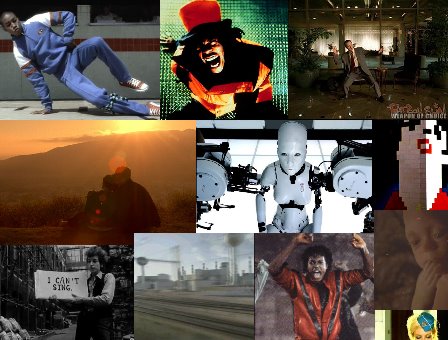

Links List
- CSC Media Main Site
- 1.Bill Haley and The Comets
- 2.Elvis Presley - Jail House Rock
- 3.Ricky Nelson - Travelin' Man
- 4.Hermans Hermits on Top Of The Pops
- 5.The Four Tops on Hullabaloo
- 6.Bob Dylan - Subterranean Homesick Blues
- 7.The Beatles - Paperback Writer / Rain
- 8.The Beatles - Strawberry Fields Forever
- 9.Easy Rider Opening Credits
- 10.Lou Christie - Example of early "Promos"
- 11.Abba - Take a Chance on Me
- 12.Queen - Bohemian Rhapsody
- 13.Elton John in Ken Russel's "Tommy"
- 14.Devo - The Day My Baby Gave Me a Surprise
- 15.Elvis Costello & The Attractions - Accidents Will Happen
- 16.David Bowie - Ashes to Ashes
- 17.Pink Floyd - The Wall
- 18.Michael Jackson - Billy Jean
- 19.Laura Branigan - Self Control
- 20.Michael Jackson's Thriller
- 21.A-Ha - Take on Me
- 22.Peter Gabriel - Sledgehammer
- 23.Madonna - Justify my Love
- 24.Nirvana - Smells Like Teen Spirit
- 25.Michael & Janet Jackson - Scream
- 26.Smashing Pumpkins - Tonight, Tonight
- 27.Bjork - Pagan Poetry
- 28.Bjork - All is Full of Love
- 29.Dirty Vegas - Days Go By
- 30.Superman Lovers - Starlight
- 31.Ash - Burn Baby Burn
- 32.Lucas - Lucas with the Lid Off
- 33.Busta Rhymes Feat. O.D.B. - Woo Hah!! Remix
- 34.Air - All I Need
- 35.Fatboy Slim - Right Here, Right Now
- 36.Fatboy Slim - Weapon of Choice
- 37.Fatboy Slim - Gangster Trippin
- 38.Tactilbox
- 39.C2C (DMC Champs)
- 40.Muse - Knights of Cydonia
- 41.Busta Rhymes - Touch It